

Longevity Nation: A Book That Should Be on Every Leader’s Desk
7 April 2026 By Victoria Tomlinson
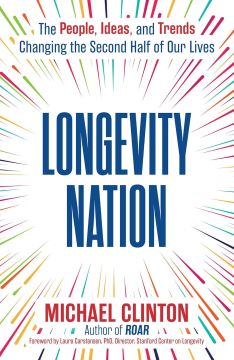
I have a confession to make. When Michael Clinton’s Longevity Nation landed in my hands, I was simultaneously excited and slightly nervous. Michael and I have been in conversation about the longevity space for a while now and he had kindly agreed to read my manuscript for Expiry Date Never, the book I have written with Louise Ballard, which publishes in September. His email this week was generous beyond what I could have hoped for. He read it cover to cover on his return from Asia, called it a deep dive into our area of expertise and suggested it could serve as a textbook in business schools. He has offered to write an endorsement and help promote it on launch.
I mention this not to boast but because it matters to the review I am about to write. We are two people working in the same space, reading each other’s work and finding genuine overlap – and genuine difference. This is a book that both confirmed and challenged my thinking.
So. Longevity Nation. What is it and why does it matter?
The scale of what Michael is describing
Michael Clinton is a former president and publishing director of Hearst Magazines and before that a publisher at Condé Nast and Fairchild. He has spent decades at the centre of media, culture and communications. His previous bestselling book, ROAR: into the second half of your life (before it’s too late), introduced the concept of the Re-Imagineers, those people ahead of the curve who are rewriting what the second half of life can look like. Longevity Nation takes that foundation and builds something considerably bigger on top of it.
The sweep of this book is genuinely impressive. Michael covers precision medicine, AI-enabled healthcare, longevity clinics, sleep science, diet and exercise, skin longevity, financial planning for a 100-year life, travel designed around wellness, advertising’s failure to speak to the over-50 market, creativity in later life, community and social connectionand urban design. He looks at what Singapore, Japan, the UAE and the UK are doing to get their cities longevity-ready. He brings in hundreds of experts, researchers, entrepreneurs and everyday people who are living differently.
If you want a panoramic view of everything that is happening in the longevity space, globally, across just about every sector, this is a must-read.
He frames it beautifully at the start. Throughout the world, doctors, technologists, investors, academics and entrepreneurs are engaged as the architects of this exciting new longevity era. Their efforts have begun to converge to create a longevity ecosystem of services, products and ideas to build the new construct for the second half of life. Whether they are designing precision medicine, a new class of longevity drugs, AI robots or new tech-enabled cities, they are the longevity innovators of our time.
I agree with every word of that. I also agree with his more sobering note that they are creating new workplace models, government policies and social structures, all to support a world where living to 100 is normalised. The difference between what is possible and what is actually happening is, at the moment, significant. And nowhere is that gap wider than in how employers are responding.
The research that should be stopping people in their tracks
Michael commissioned substantial research through ROAR Forward, his joint venture with Hearst, working with the National Research Group. They surveyed 1,500 people aged 50 to 70, balanced by age, gender and ethnicity. The findings are striking.
85% reported that post-50 is the new prime of life. 95% said they are coming into that prime energised, motivated and focused on their next chapters. One in three identified with the characteristics of a Re-Imagineer. These are not fringe people. They are a third of this generation and 74% of the wider population said they aspired to be like them.
The frustration in the research is real too. 91% want to see more modern images of what it means to be their age. 62% say they notice and respond negatively to outdated stereotyping in advertising. One in five has stopped buying a specific brand because it failed to connect with people over 50. That is not a small number. Advertisers and marketers are losing business and most have failed to notice.
On work, the data is equally clear. 85% of those still working for pay do so because they want to stay active and involved. 80% because they enjoy it. 88% say it is important to help others and be of service to their community. These are not people clinging on because they have nothing else. They are people at the peak of their capability looking for places to contribute.
Where our books differ and why that matters
Both our books are global though Michael’s lens is more from an American lens, mine and Louise’s more from a UK perspective. Both books argue that the second half of life has been catastrophically undervalued and that this needs to change urgently.
Where I think Expiry Date Never adds something different is in the granular detail of how individuals actually make transitions. Not just the what, but the emotional stages people go through, the psychological weight of stepping out of a long identity, the very practical barriers around money, networks and confidence. Michael introduces us to remarkable people who have made extraordinary pivots and those stories are inspiring. Our book tries to show not just that it can be done but how it feels from the inside and what the tools and steps are for people who are not yet sure where they are going.
The one area where I found myself wanting more in Longevity Nation is around the role of employers. Michael covers business extensively, but often through a wider economic view. The chapter on workplaces reimagined for longer lifespans is genuinely important and I was pleased to find some of the same ground we cover. U-Work at Unilever is a great example and gets a mention in both books. Morag Lynagh, who is now working with us informally at Next-Up, has been central to that model and it is good to see it get the recognition it deserves.
Michael also covers Pro-Age, the UK-based charity run by Mike Mansfield, who works with major companies including Coca-Cola Euro Pacific Partners on creating age-inclusive cultures. Their survey of 225 organisations found an average score of 7.2 for acknowledging the demographic challenge as important, but only 4.2 for strategic preparedness to act on it. That gap says everything about where most employers currently sit.
Michael looks at the French initiative, the Club Landoy charter, where 136 companies including Air France, L’Oréal and AXA have signed up to commitments around retaining, retraining, promoting and hiring employees over 50. I wrote about this in a blog and when I dug further I found the picture was more complicated than it first appeared, with trade unions playing a more central role than employers. You can read my thoughts here.
What I keep coming back to is this. For all the extraordinary innovation Michael documents, employers remain the weakest link. He is clear-eyed about it. Businesses have been slow to recognise this as a major issue. The talent drain is real, the demographic cliff is real, the skills gap is real. And yet most organisations are still operating on systems that were designed for a world where average life expectancy was 47. We are now heading towards 100. Nobody has updated the operating manual. Our systems, our HR models, our career structures, our retirement expectations, all of them were designed for a life that no longer exists.
The statistics that keep surprising people
One number Michael cites that never fails to land hard in a room: 50% of children born today are likely to reach 100. When our mutual friend, Avivah Wittenberg-Cox, shared this at our recent Professional Services Retirement Forum, the HRDs in the room went quiet. These are senior, intelligent people who have not registered what the new (ish) longevity actually means for career planning, for pension provision, for workforce design. The information is out there. The penny has not yet dropped.
Michael references Ray Kurzweil’s The Singularity Is Nearer, which explores what the future might look like when AI and nanotechnology combine. Kurzweil suggests that nanorobots patrolling our bloodstreams, lab-grown organs and AI-enhanced cognition may eventually push us well beyond the current maximum human lifespan of 122 years.
Michael’s response to sceptics is right: no-one should dismiss this as impossible when you look at the marvels of technology already in our hands. I agree with Michael that we should be planning now not just for healthy lives to 100 but for what comes after. If that feels alarming, it should. Because our systems are still designed for a world where most people died before their retirement age.
How long has this been coming?
One of the things I find both heartening and quietly devastating about Longevity Nation is the history it traces. Ken Dychtwald and his wife Maddy founded Age Wave in 1986 to raise awareness of demographic change. Joseph Coughlin founded the MIT AgeLab in 1999. Peter Peterson wrote Gray Dawn in 2000. Laura Carstensen cofounded the Stanford Center on Longevity in 2007. These people have been raising the alarm for decades.
And yet here we are in 2025, still describing Re-Imagineers as trailblazers rather than the norm. The fact that people who are living full, purposeful, productive lives in their 60s and 70s (and actually in their 80s, 90s and beyond) are still seen as exceptional tells you everything about how far the conversation still needs to travel.
I love Michael’s formulation of this. The Re-Imagineers say 60 is not the new 40. It is the new 60. And 70 is the new 70. These are people drawing on wisdom and experience that simply was not available to them at 40. They are not pretending to be younger. They are being fully, richly themselves.
This year is remarkable for the number of books landing on this subject. Michael’s Longevity Nation publishes on 8 May. Lucy Standing’s book, Age against the Machine, is launching on 16 April. Lyndsey Simpson’s Age Rebellion is due in May. And Expiry Date Never follows in September. A wave of thinking, all arriving at roughly the same moment. The question I keep asking myself is whether we will look back in a decade and see this as the turning point, or whether we will still be writing the same books and asking the same questions.
What the book covers and what it does not
Michael’s chapter range is extraordinary. Financial planning for a 100-year life. The new longevity medicine and the role of AI in healthcare to advertising’s blindness to the over-50 market. All of this is covered with depth and care. Much of the health and science territory overlaps with what Dr Sarah Hattam has written for us in Expiry Date Never, approached from slightly different angles. Where Michael brings the American and global innovation perspective, we bring the lived reality of the UK workplace and individual transition.
There is one area I was surprised to find less developed. His chapter on higher education is fascinating, full of inspiring stories including Michael’s own return to Columbia to do a Master’s in nonprofit management in his 50s. He makes the strong point that universities face a demographic cliff as 18-to-24-year-old student numbers decline and that mid-career professionals represent a huge and growing opportunity for them. This is right and important.
But what he does not address and what worries me, is that universities globally are still failing to embed longevity thinking into their core curricula. Business strategy courses are not routinely teaching students about the economics of an ageing population. HR programmes are not built around workforce models that reflect 60-year careers. Medical schools are changing, but slowly. If we are serious about a longevity nation, we need to change what we teach before people launch their careers, not just offer them refresher courses once they reach midlife.
Why I am glad this book exists
Michael kindly invited me to the London launch of this book, sadly I can’t make it. I would have loved to be there, not least because the conversation between people working in this space is where some of the best thinking happens. But also because Michael himself is an absolute inspiration. Now 72 he is running marathons in every country he visits. Wow!
Longevity Nation is a book with genuine ambition. It wants to show the full scale of what is possible and to make the case that a world where living to 100 is normalised is not science fiction but a practical and urgent project that requires action from governments, businesses, institutions and individuals right now.
Michael is right. There is still an enormous amount of work to do. Employers are a long way from either recognising or responding to what is coming. But the ecosystem he describes, scientists, technologists, investors, educators, city planners, healthcare innovators, all beginning to work in concert, is real. The momentum is building.
This book will help build it further. Read it alongside Expiry Date Never when it comes out in September if you want both the panoramic view and the ground-level detail of what it actually takes to live and work differently in the second half of life.
Longevity Nation by Michael Clinton publishes on 8 May 2026. Congratulations Michael, your book is brilliant!

Written by Victoria Tomlinson
Victoria Tomlinson is chief executive and founder of Next-Up. Next-Up supports employers with a range of services for directors, partners and employees to help them understand the impact of retirement on mental health and create a plan to use their skills and experience in new ways to ensure wellbeing. A key part of our role is to inspire people with ideas and contacts, beyond traditional expectations. A former director of EY, she is an international speaker on unretirement, personal branding and using LinkedIn strategically as well as on leadership and women on boards. She mentors chief executives and directors, start-up businesses and ex-offenders. Victoria is Honorary Teaching Fellow at Lancaster University and chaired an advisory board for University of Leeds.
