

Partner Retirement in Law Firms
26 August 2025 By Victoria Tomlinson
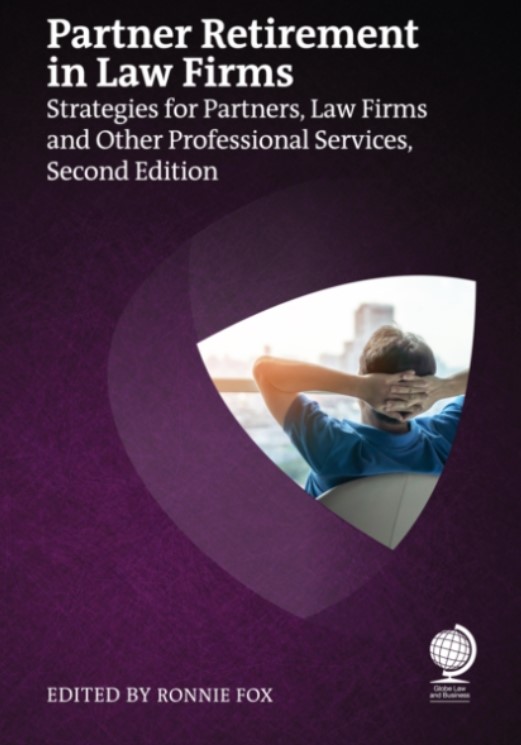
I was asked by Ronnie Fox, editor of Partner Retirement in Law Firms, to review the newly released second edition of this book. It’s encouraging to see the subject of retirement being discussed more openly. For too long it’s been such a sensitive topic that partners and firms have tied themselves in knots trying to deal with it.
What sets this book apart is its focus on an area rarely covered elsewhere: the tax and accounting process at the end of a partner’s career. In one of our workshops for a Big 4 accountancy firm, an alumnus speaker shared his surprise and delight at receiving cheques from the firm over the first two years of retirement – as estimated profits were adjusted and paid out. It’s clear most partners don’t spend much time poring over the Partnership Deed they signed 20 or 30 years ago!
A small caveat: the book seems more aimed at smaller legal firms with only a handful of partners. For example, the Executive Summary refers to partners working “into their 60s and 70s” and the “valuation of assets such as goodwill.” We’ve worked with more than 600 partners from firms of all sizes, and only a handful have been in their 60s – none in their 70s – and I haven’t come across any firms still having goodwill to value.
That said, much of the content will resonate with all partners and their firms.
Accounting and Practical Considerations
This chapter, written by Andrew Baker of RSM, is highly technical. He explores how retirement dates tie into the firm’s year-end accounting – even the time of day you leave can have an impact!
He raises several points that partners may want to check or negotiate around the calculation of final-year profits, for example:
- Substantial investments in technology (particularly AI) or new premises can distort short-term profits. Firms may need to adapt profit sharing for retiring partners, ensuring they still vote for and support long-term investments.
- Changes to UK GAAP mean that after 2026, some leased assets, such as property, will be brought onto the balance sheet, affecting accounting periods.
- Stamp duty land tax might arguably be expensed over the period of a lease but is often written off as part of premises costs.
- A post-retirement assessment of trade debtors (say, 12 months later) can check whether provisions have been realised.
- Averaging actual profits over three to five years could ensure greater fairness.
Tax Considerations
This chapter, by Nicky Owen of Crowe, is equally technical. It lays out scenarios with different retirement dates and shows how tax treatment depends on the firm’s accounting year-end.
She demonstrates how tax liabilities in the retirement year – and the years immediately after – can vary significantly depending on these dates. Most legal partners will want to consult their own IFA or the firm’s finance director for detailed planning, but this chapter underlines that the timing is worth close attention.
What Next and the Emotional Impact
Three chapters, written by Micheline Hogan, Veronica Mann and Roderick Chamberlain, focus on the emotional impact of retirement, building a retirement plan and creating another career.
They highlight the sense of loss many partners feel, the value of having a plan and the need to start financial planning by around age 45.
One concern: the book repeatedly references non-executive director roles as if they are easy to secure. In reality, very few partners will be shortlisted without prior non-exec experience – and, being blunt, if they are a white man. Too often, coaches encourage partners to define what they want without addressing the realities of the market.
Success comes from doing the groundwork: having countless coffees to understand how the “outside world” operates, learning how they are perceived and leveraging contacts to secure roles. It is possible, but it requires persistence and effort – and I felt this reality was missing from the book.
Combative or Collaborative?
As a non-lawyer, I was struck by the expectation of a “fight” at the end of a partner’s career. Early chapters by Corinne Staves of CM Murray and Ivor Adair and Caroline Field of Fox and Partners cover age and disability discrimination, restrictive covenants, whistleblowing protection and more.
Firms are beginning to recognise this adversarial approach is not a healthy way to conclude a long and loyal career. Encouragingly, change is happening – and I’m pleased that our workshops are helping to normalise conversations around retirement.
That said, too many partners’ careers still end in conflict. This book highlights the issues and provides useful checklists to help reduce the risk. But it also reminds us that partners may have another 10, 20 or even 30 years of meaningful engagement with business and society. They can be ambassadors, mentors, and catalysts for change.
The challenge – and the opportunity – is to stop seeing retirement as an ending and start seeing it as the next chapter in a partner’s life.

Written by Victoria Tomlinson
Victoria Tomlinson is chief executive and founder of Next-Up. Next-Up supports employers with a range of services for directors, partners and employees to help them understand the impact of retirement on mental health and create a plan to use their skills and experience in new ways to ensure wellbeing. A key part of our role is to inspire people with ideas and contacts, beyond traditional expectations. A former director of EY, she is an international speaker on unretirement, personal branding and using LinkedIn strategically as well as on leadership and women on boards. She mentors chief executives and directors, start-up businesses and ex-offenders. Victoria is Honorary Teaching Fellow at Lancaster University and chaired an advisory board for University of Leeds.
