

Why longevity research matters and how employers can lead the way
26 November 2025 By Victoria Tomlinson
Well done to Canada Life for their incredibly detailed research into longevity and what it means for employers and employees. It is encouraging to see a major organisation take this topic seriously and invest in understanding how our working lives are changing.
But. And it’s a big but.
Even this future-thinking company slips unintentionally into ageism – not out of bad intent, but because so many of our systems and assumptions simply haven’t caught up with 21st-century longevity.
Below, I highlight the headlines from the research, where ageism creeps in and – importantly – what employers can do to get this right. This isn’t about criticising Canada Life; it’s about using excellent research to spark the action employers now need to take.
The headlines: longevity is no longer a niche issue
Canada Life’s findings make one thing very clear:
- 90% of large private-sector employers believe it’s important for people to remain in the workforce until State Pension Age and often beyond
- 87% of employers are aware we’re living longer, with more people expecting to reach 100
This is a huge shift. Employers understand that experience is essential to the economy, their sector and crucially their own business.
But the Gap Between Intention and Action Is Stark
There are over 1 million people aged 50–64 who want to work but can’t get a job, and 2 million people aged 50+ claiming benefits (not including pensions).
So, you would expect to see employers updating how they recruit, retain and support this generation.
Yet the research shows the opposite:
- Only 29% value skills alongside qualifications, disadvantaging older workers who grew up when university was for the elite
- Only 25% support flexible working for carers, even though this helps older workers and younger parents alike
- Only 25% offer phased retirement, something we know keeps people working longer
- Only 20% ensure equal opportunities for all ages, despite this being a legal requirement
- Only 18% ensure tech skills are continuously updated across the workforce – shocking given the digital and AI transformation underway
These aren’t small gaps; they are organisational blind spots.
Why are employers so out of touch?
One example leaps out.
55% of employers think older workers leave early because they are physically unable to do the job. In reality, just 18% do.
Two-thirds of employers do not know why older staff leave.
This isn’t just ageism. It’s poor people management. And an enormous risk when so much knowledge is walking out of the door.
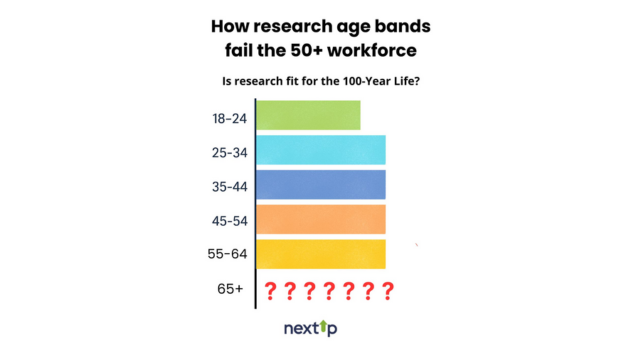
The age brackets that limit expectations
Canada Life’s own age segmentation also reveals an outdated mindset:
- 18–24 (6 years)
- 25–34 (10 years)
- 35–44 (10 years)
- 45–54 (10 years)
- 55–64 (10 years)
- 65+ (a 35–45 year span!)
With more people working into their 70s, 80s, 90s and even beyond 100, we urgently need new age categories: 65–74, 75–84, 85–94, 95+.
If we don’t count older workers properly, we mask their contribution and distort the data that shapes policy.
The real meaning of progression and fairness for the 50+ workforce
Canada Life comments that:
“As we get older, we need different things from work.”
This made me wince, because the research base was tiny, and because it simply isn’t what we see with thousands of 50+ employees.
Here is what most people over 50 actually want:
- Equality in recruitment – to be judged on contribution, not age
- Interesting work with meaning and purpose
- A manager who treats them as a respected colleague, not an age category
- Training, development and chances to progress
- Opportunities to learn, grow and make a difference
This is almost identical to what younger generations want. When organisations introduce “older worker” policies, they usually become “all worker” policies — and everyone benefits.
Younger generations are working differently — and older workers can too
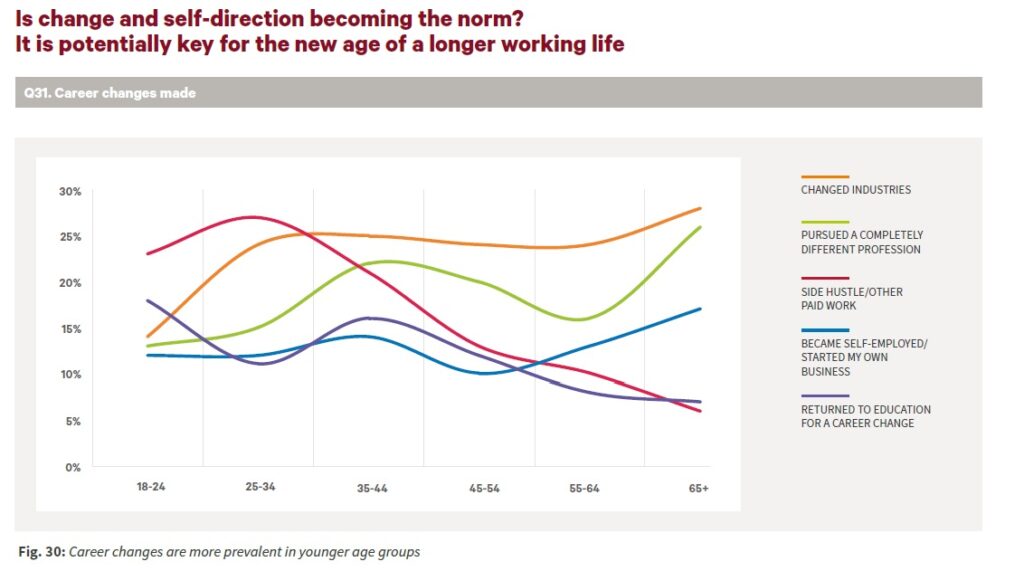
It’s predictable and reasonable that younger generations expect portfolio careers, side hustles and frequent change. They’ve grown up with digital tools that make this possible.
Many in the 50+ generation haven’t and lack confidence online. Employers could make an enormous difference simply by pairing younger and older colleagues on projects. Both groups gain skills the other doesn’t have.
Canada Life deserves credit
It is laudable that Canada Life has invested so much in this work. Every piece of research like this moves the dial forward. And of course, every organisation has commercial interests, so it’s no surprise that some findings align more closely with their products.
My point is not to dismiss the research, but to build on it.
Next time, I hope experts such as ourselves, @Avivah Wittenberg-Cox, @Lucy Standing, @Kay Allen and @Lyndsey Simpson can contribute to designing the research and interpreting the findings. Together we could move the national conversation on longevity forward at pace.
What employers can do now: A practical checklist
Here are clear, constructive steps drawn from the evidence above – actions that organisations can adopt immediately.
1. Update recruitment practices
- Value skills and experience, not just qualifications
- Remove age-coded language from job ads
- Train managers to eliminate unconscious age bias
- Monitor shortlisting to ensure older applicants aren’t silently filtered out
- Review career pages and imagery does it subtly signal “younger only”?
2. Equip managers to have good career conversations
Most managers don’t know how to talk about future working lives, development or contribution with mid- and later-career employees. Give them simple tools and structure.
3. Create space for people to talk about what they want next
Not everyone wants to progress. Some want to grow, pivot, mentor or stabilise.
You won’t know unless you ask – properly.
4. Recognise the value of experience in day-to-day work
Bring teams together to share knowledge, understand working styles across generations and stop tacit know-how getting trapped in silos.
5. Re-engage mid- and later-career colleagues
Many in their 40s, 50s and 60s are reassessing their work.
A simple reset conversation can uncover fresh energy and contribution.
6. Review development and upskilling opportunities with a longer working life in mind
Most older employees want to learn but opportunities often stop being offered to them.
7. Make intergenerational working intentional
Quick, practical sessions can improve collaboration, reduce friction and strengthen onboarding.
8. Audit recruitment, progression, reward and redundancy through a longevity lens
- Are people across all age groups being recruited fairly and without hidden age cues in adverts or screening?
- Are progression rates balanced across early, mid and later-career employees?
- Is pay equitable across age groups and job levels?
- Are redundancy decisions disproportionately affecting particular generations -younger or older?
Small shifts in these structural areas can have a major impact on fairness, retention and organisational trust.
9. Fix age categories in data
Stop grouping everyone aged 65+ into a single, unrealistic bracket.
Track meaningful age bands: 65–74, 75–84, 85–94 and 95+ this reflects real working lives and prevent hidden bias.
10. Spot early signs of disengagement
Quiet withdrawal reduced volunteering for projects, or “silent competence” often signal someone feels stuck or undervalued.
11. Review how accessible your internal processes are for a workforce spanning 18 to 70+
Job design, performance frameworks and mobility routes are often built for a 1990s career model. Small adjustments make a significant difference.
12. Listen to your 50+ workforce – properly
No industry survey replaces listening to your own people.
Ask what would help them stay longer, contribute more and feel valued.
This is how employers unlock the huge, often untapped value of the 50+ workforce and prepare for the 100-Year Life.
At Next-Up, much of our work centres on supporting these conversations and helping organisations bring their future-of-working-lives strategies to life. It’s often the missing piece.

Written by Victoria Tomlinson
Victoria Tomlinson is chief executive and founder of Next-Up. Next-Up supports employers with a range of services for directors, partners and employees to help them understand the impact of retirement on mental health and create a plan to use their skills and experience in new ways to ensure wellbeing. A key part of our role is to inspire people with ideas and contacts, beyond traditional expectations. A former director of EY, she is an international speaker on unretirement, personal branding and using LinkedIn strategically as well as on leadership and women on boards. She mentors chief executives and directors, start-up businesses and ex-offenders. Victoria is Honorary Teaching Fellow at Lancaster University and chaired an advisory board for University of Leeds.
