

The 2026 year book trend – three books for the magical 50+ generation
10 June 2026 By Victoria Tomlinson
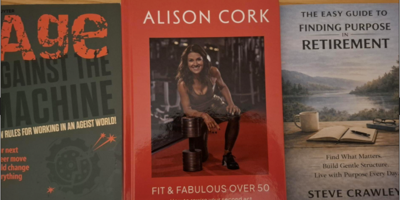
I am being asked to review books and sent copies – you know when you have achieved a clear personal brand because all the books are spot on for what we are doing!
These three books are Age against the Machine by the rather wonderful Lucy Standing, psychologist and founder of Brave Starts; Alison Cork, former food critic who lost five stone and turned 60 fitter than ever before with Fit and Fabulous over 50; and Finding Purpose in Retirement by Steve Crawley. Steve modestly doesn’t reveal much about his early life only ‘after decades of work and responsibility, Steve became aware that retirement is rarely just a financial transition’. Quite!
Of course I am particularly interested in these books because Louise Ballard and I have written Expiry Date Never: Age is the New Superpower which is being published by Pearson in September.
Age against the Machine
I have been meaning to write this review for ages and to be honest, it was listening to Guy Martin on R4 Desert Island Discs choosing Rage against the Machine as one of his music choices that spurred me on. When I heard this I went aaaah, that’s what the title is about! I mention this because Lucy is quite a cool chick!
When Lucy told me about the book last year she said, “It is academic”. I don’t think that is the word I use, but all of the three co-authors are highly qualified academics and the book is rooted in both academic evidence as well as highly practical stories and examples.
Lucy echoes our book (or do we echo hers?!) that retirement is no longer fit for purpose and talks about how work is the cornerstone of purpose, income and connection. Like ours, this is a handbook on how to reinvent yourself, find purpose and build new connections. I thought with the title that it would look at how AI can help you (which ours does) but does talk about the challenges of fighting the system where employers reject the 50+ generation’s job applications out of hand.
She also advises to try and help employers for free to get new skills and current CV experience and the one thing we all bang on about, you have to build new connections and get in touch with dozens if not hundreds of people.
Success is possible and for all the challenges, this is an optimistic book and I recommend it.
(As an aside, I am very envious that Lucy’s publisher allowed photos and colour ones at that!)
Fit and Fabulous over 50
The first thing you have to comment on with this book is the cover – it is in your face. And to be honest, I really can’t decide what I think. Alison is apparently 60 and she looks amazing. She says she is just an ordinary woman, no exercise freak and in fact, never exercised until she was in her 50s and that anyone can do what she has. Good on her!
This book is a practical guide that “covers food, exercise, appearance, social habits, mental attitude and inexpensive, easy to adopt changes”.
The book is based on her own story, looking in the mirror at a Bridget Jones type torso and deciding to join a gym, get professional help and combine with nutrition advice.
I think it has to be a woman’s book, though the tips apply to any gender. To be honest, if you are generally aware, I didn’t feel there was anything new in any of this, it felt more like a compilation of all the magazine articles I had read on all the topics.
As you would expect from a food critic, there is considerable focus on food – the theory, recipes, lovely photos of healthy dishes and practical tips to change diet habits and above all, mindsets.
She does cover how to look good by ‘amplifying your assets’ rather than focusing on what you want to avoid/cover up.
It’s a very sensible book and despite a seriously aspirational cover photo, I think any woman (and probably man too) could find a lot to help you get healthy for a long and happy life.
Finding Purpose in Retirement
Steve Crawley’s book is a much quieter, shorter and focused book – actually I am not one for gender differences, but I do think it is perhaps more male. Certainly than Alison’s book!
Apparently this is one of a series of ‘Easy to’ series. To be honest, I skimmed this hoping to find that magic solution to helping others find purpose in retirement. There is no magic wand.
This book is also practical, getting you to think about what you care about and are interested in. If you are thinking about all this for the first time, then it is probably a useful first step.
I am not sure it takes you far enough for where most people I know want to go – which is finding ways to use their skills after working life. Steve is far more hobby and relaxation-focused and there is a place for this. I know I get criticised for helping people to be more ‘work-focused’ but that is what most of my market is wanting. 86% of the people I work with start out wanting to be non-execs, which tells you a lot.
In Steve’s case, the examples he gives are James becoming a tour guide; Michael who is painting landscapes; a genealogy teacher and someone teaching the ukelele. All of these are fine ‘retirement’ activities but for many they want to achieve much more at this stage of life.
Although a quick read, Steve manages to cover family relationships, finances, ikigai and more.
If you were a high achiever, I suspect you will think you want more than this book is aiming for. But a lot of people want to know what is it like spending time in a traditional retirement way – I suspect you would feel this book helps you understand that. It’s up to you then whether that is what you want – or not.
All three books are worth a read, many of the messages are repeated time and again in different ways – which is a really good thing. And I think they will all be a wake-up call that you should not just drift into retirement but you need to do a lot of thinking and planning – and ideally some years before you actually leave ‘work’. Five years is not too long.
Well done to all the authors and good luck to everyone going through this. I hope you will find our book adds further perspectives and detail later in the year (as well as addressing government, employer, charity and university issues for this age group).

Written by Victoria Tomlinson
Victoria Tomlinson is chief executive and founder of Next-Up. Next-Up supports employers with a range of services for directors, partners and employees to help them understand the impact of retirement on mental health and create a plan to use their skills and experience in new ways to ensure wellbeing. A key part of our role is to inspire people with ideas and contacts, beyond traditional expectations. A former director of EY, she is an international speaker on unretirement, personal branding and using LinkedIn strategically as well as on leadership and women on boards. She mentors chief executives and directors, start-up businesses and ex-offenders. Victoria is Honorary Teaching Fellow at Lancaster University and chaired an advisory board for University of Leeds.
