

Who am I? The hardest part of unretirement?
3 August 2021 By Victoria Tomlinson

Of all the challenges people face as they retire, the hardest and least expected is – who am I?
After 30 or so years in one organization, this is rarely an issue that has even crossed their mind. They are chief executive, partner in law firm x or accountancy firm y, finance director or whatever.
Once they have departed corporate life, they are left saying ‘who am I?’
In this blog, I will share with you some of the issues we see and give you a route to creating your new identity. I have to say, I think the transition phase itself is the most difficult part of this – you may still be working for your old firm or company as you start exploring new routes. You need to be seen as passionate about your firm and role while getting people to see you in a new light. As soon as you have left, ideally you want to start saying ‘I am…’ (in answer to that awful question, what do you do?) rather than ‘I was …’ – but you are still exploring and haven’t quite decided what you are going to do.
1. Why does ‘I am ….’ matter?
Quite simply, if you introduce yourself to others as, ‘I was partner at x’, no matter how prestigious your old firm or company, you sound like a has been and living on old glories.
Instead, if you say ‘I am mentoring an entrepreneur’ or even ‘I am looking to see how I can use my skills to help charities’ you immediately sound current and relevant and position yourself in other people’s minds. If someone is looking for a mentor or they come across a charity looking for help, you may pop into their mind.
‘I was’ doesn’t help in any way.
You might want to look at this video interview with David Morley – he was senior partner at Allen & Overy, one of the world’s largest law firms. And still he struggled.
2. The three stages of your identity
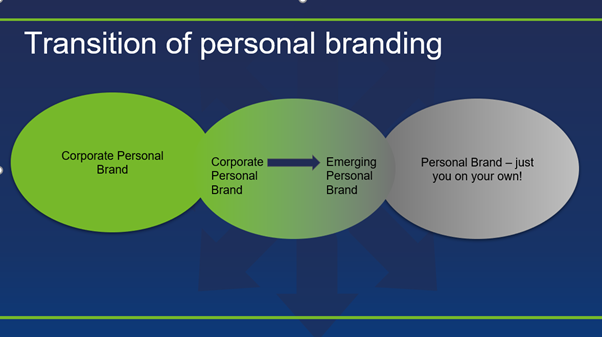
You need to plan/create an identity for three key stages. You will have had a corporate-focused personal brand for years. In the months or year or two before you unretire, you want to start adding on a personal identity that supports your corporate activities but starts positioning you in a new way for when you leave. And this new brand needs to bring out skills and expertise that will be relevant to the future. The third stage is once you have left and are on your own.
Hopefully when you leave you will have a personal brand that works for the first six months or year as you get going. It will probably evolve and change as you understand the market more, find opportunities and probably find yourself focusing on one or two areas.
As an example, you may qualify as a coach (though I should warn everyone becoming a coach that this is a saturated and fiercely competitive market – just ask your HR team in your firm! They are typically inundated with former partners and managers who have qualified and want to work with their old company). Despite this, let’s suppose you have qualified. So you could mention your qualification and start posting on LinkedIn thoughts and insights about the challenges that people face at work – and the role of coaching.
3. Ideas for personal brand
Let’s give some more specific examples to all this. Take a litigation lawyer who now heads up their firm’s global arbitration practice. Their corporate brand would be more about expertise in arbitration, perhaps chairing an international arbitration body, being mentioned in Legal 500 for their expertise.
There is only a small chance that any of that is going to help them win roles in the future, unless they plan to continue some sort of legal career.
However, what might be of interest and give them a platform for the future are some of these things
- Sitting on the firm’s Net Zero committee, agreeing headline targets for the firm and working through these targets to individual parts of the firm. Setting up a best practice group with five FTSE corporates to share learning
- Focused on increasing diversity in our firm. Have mentored five female directors to become partner in teams where there were no female partners before. Set up internal support groups looking at LGBTQ, ethnicity and gender equality
- Led the firm’s international expansion to the Middle East and Africa, opening offices in Dubai, Nairobi and Nigeria. Set up partnerships in telecoms sector with leading players in each of these countries
- Set up the firm’s litigation practice 20 years ago, growing to 50 partners globally through a mix of lateral hires of teams along with internal recruitment and training
None of this detracts from the commitment to the firm, but they do start giving some kind of personality and focus for ‘life beyond the firm’.
Of course, you want this new personal branding side to match market needs. I have suggested the above as a focus because
- Earlier this year, I heard a speaker who advises corporate boards say, “Every single corporate that I am working with now has ESG (Environment, Social + Governance) top of every agenda”. To be honest, I was surprised – I know these topics have become big issues, but I would not have thought they were top of an agenda. And this is why you need to have a lot of conversations to know what are the issues in any market you are keen to explore. And then start positioning yourself there. You can read more about purposeful conversations in this blog – under point 5. So I have chosen areas where I think many organisations could be looking for help – increasing diversity, international expansion, Net Zero targets. These could be non-executive directors, advisory roles, consultant, charity trustee or even short term projects
- I then chose international expansion – this is something that organisations often look for, both in terms of understanding those markets but also having connections and networks in those places which can be hugely valuable. You will see I mentioned forming partnerships locally
- And then I included something that a lot of leaders have done, which is essentially to build and run a business within your organization – recruiting, winning business, creating strategies for growth, managing people/IT and more. In this interview with Pat Billingham, former tax partner at EY, she says that headhunters tend to think of partners in the big 4 as being clever professionals, but not as people who run In repositioning herself, she had to bring out in her CV that she was a businesswoman and could bring that experience to boards.
4. Use LinkedIn to reinforce your brand
Iain Wilkie, another EY partner, is a great example of how to do this – he is a wonderful speaker and hugely engaging on our programmes. If you look at his LinkedIn profile below, you can see he is a coach for quiet leaders (very clear positioning in that crowded coaching market) and founded 50 Million Voices, a charity to help people who stutter at work. He has both these on his professional headline (though he could also have added ‘to help people who stutter at work’ to explain 50 Million Voices – there is space).
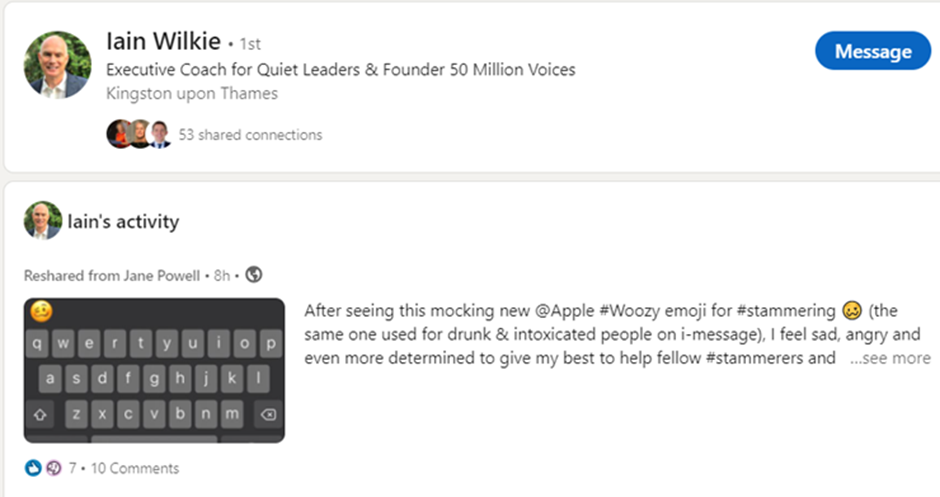
You will see Iain also shares, comments and posts content that reinforce/build his brand. Look at the post that he shared above about the emoji for stammering – and below his posts about what he is doing. There is no doubt about his passion or what he does?
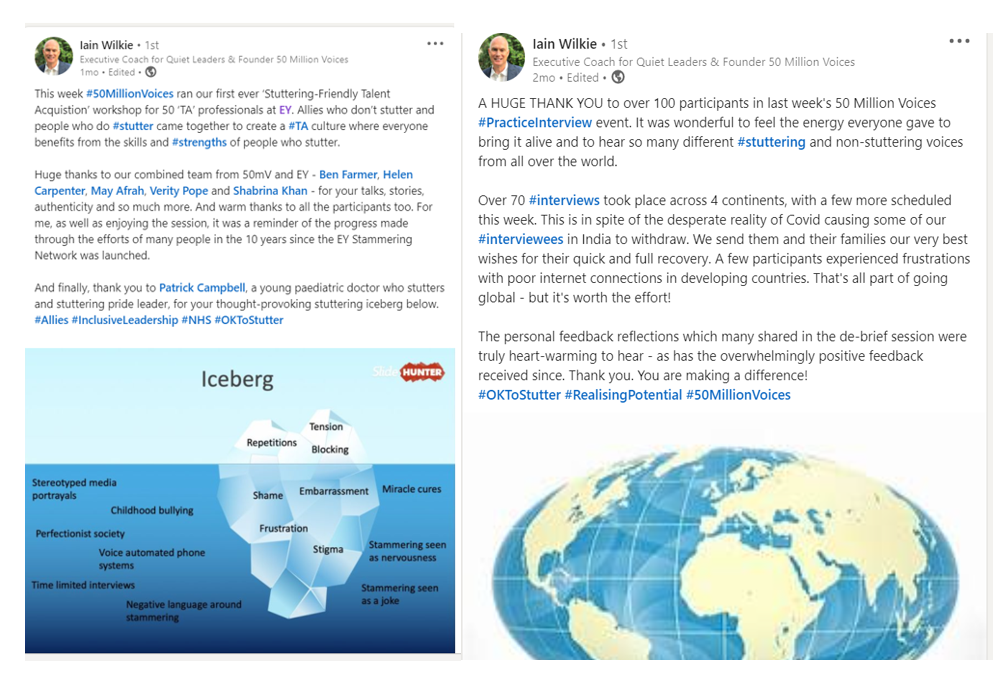
Iain has supported people who stutter all through his career and was on EY’s disability forum. So he could have built his brand on LinkedIn in this area before he left (I seem to remember, like most partners, he wasn’t that active on LinkedIn while at EY!)
5. Your CV should reflect your personal brand
One of the hardest parts for newly unretired people, is writing a CV. For many, they haven’t written a CV since they got their first job. And it’s a bit of a shock how different a CV for a non-exec/trustee/advisory role is from the classic executive CV.
The first paragraph – in fact, line – needs to sum up who you are and what you bring to the party of whatever role you are seeking. Ideally your new personal brand will be relevant here. As Pat Billingham explained, in her case it was not her expertise as a tax professional but how she grew her ‘business’ at EY. You want to demonstrate understanding of board issues and skills in the areas that boards recruit for – back to your personal brand in areas that boards want.
6. Develop questions and conversations around your brand
As you explore and develop your brand, you want to focus on areas that will help you understand issues and demonstrate to people your skills and/or interest in the topics of your personal brand.
Going back to the examples above, if you have a coffee with a chairman, you might want to ask where ESG is in terms of board priorities and what is the biggest challenge in this. Or maybe talk about skills challenges and how your recruited talent in a difficult market, to build your team.
Your networking is all part of building awareness of this new focus of yours.
Over time, you may well feel that what you started out with is no longer interesting or that you can’t add much value. As you change direction, make sure that your LinkedIn, CV, conversations and posting all reflect this.
That is the way to ensure you come to mind when people have a relevant challenge or are looking for expertise to help them.
Your personal brand is making sure you are front of mind when these opportunities come up.

Written by Victoria Tomlinson
Victoria Tomlinson has spent her career challenging how work is done and who gets to do it. One of the few women in senior roles early in her career, she built a track record of "firsts", from being the first female graduate trainee in a 20,000-employee engineering business to becoming one of the youngest leaders in EY's London practice, where she led a division of 100 people and drove a major culture change programme. She went on to found and run an award-winning communications agency while raising a family, later expanding internationally with an office in Dubai. In her 50s and 60s, Victoria reinvented again – becoming a BBC Expert Woman commentator, launching Next-Up to help the 50+ generation rethink their working lives and more recently building a tech platform piloted by a major bank to support longer, more flexible careers. Today, as CEO of Next-Up, she works with leading professional services firms and corporates to help them unlock the value of experienced talent. Her work has created a global community of firms rethinking partner careers and later-life transitions. Victoria is an international keynote speaker, TEDx speaker (A Generation of Wasted Talent) and Amazon bestselling author. She is a Teaching Fellow at Lancaster University, a Fellow of the RSA, and has held board roles including founding Chair of WILD Digital, University of Leeds Management Advisory Board and on the board of Northern Ballet. She also supports employment initiatives for ex-offenders through HMP Askham Grange. Expiry Date Never brings together the insights from her work with individuals and organisations to challenge how we think about age, work and experience and to show what needs to change.

Next-Up — Experts in 50+ employees
https://www.next-up.com/insights/who-am-i-the-hardest-part-of-unretirement/