

Would this solve the mental health crisis – and help NEETs and the 50+ unemployed?
3 July 2026 By Victoria Tomlinson
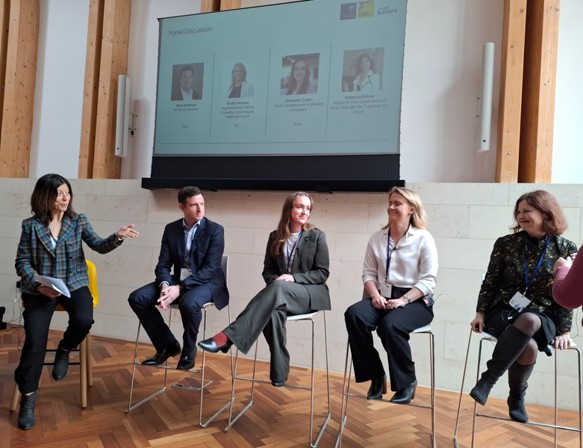
Earlier this year, I was invited to join an Oxford University conference on Gen Z and intergenerational dynamics in the workforce. The day started well when I met Rebecca Robins, co-author of Five Generations at Work that she wrote with Patrick Dunne (a fellow former EY colleague) – and we had a great discussion on this multi-generational territory. Rebecca is pictured to the right of this panel.
I have been wanting to write about this for ages, but as I have mulled what I heard I have also been thinking: what can we actually do? And then last month Alan Milburn came out with the sobering report on our young people and their lack of work and training. There was actually nothing new in it – it just brought together many issues and put a spotlight on the total picture. Let’s start with Oxford and then look at possible solutions.
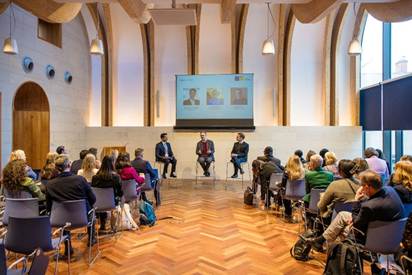
The headline speaker at the Oxford Elevate event was Paul Johnson CBE, Provost of Queen’s College Oxford and one of the UK’s most respected economists (pictured centre of the panel).
He was warm, slightly self-deprecating and laid out the economic reality facing younger generations with quiet authority: stagnant real wages since 2008; a housing market that has shut out middle earners; a pension system that has shifted dramatic risk onto younger workers; and a tax system where a 27-year-old graduate faces a 37% marginal rate while a 67-year-old earning the same pays 20%. The data on wealth versus income was particularly striking – national wealth has surged to £12 trillion while wages have flatlined.
We all know that the Boomer generation – and to an extent Gen X – has been extremely lucky in so many ways, from house prices to pensions. It is right that my generation should feel uncomfortable when we are reminded just how much the cards have been stacked in our favour for decades. But that is for another blog.
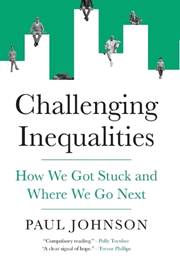
And it isn’t just about young people. Paul’s data also highlights a growing problem that receives far less attention: the 2.15 million people aged 50–64 who are economically inactive. Nearly a million young NEETs on one side, over two million experienced workers sidelined on the other – and yet public debate overwhelmingly focuses on the former while treating the latter as invisible. Part of that is societal: we still carry deeply embedded assumptions that once someone is past 50, they are somehow past their best, when the evidence simply does not support that.
Alan Milburn’s review puts the number of young people described as NEETs (Not in Education, Employment or Training) at 957,000 and rising. The fiscal cost of not addressing this is put at £26bn. But we need to be honest about what problem we’re actually solving – I think we’ve been misreading the problem.
The dominant narrative goes something like this: young people are struggling with their mental health, and that’s why they can’t work. Fix the mental health, get them into jobs. It sounds logical. But in many cases it has the causality exactly backwards – and this is an argument I make at length in my book Expiry Date Never.
In the book I highlight the generation of experienced, capable people being quietly frozen out of the workforce – made redundant, passed over, managed out – and then told the door is open if only they’d update their LinkedIn or accept a more junior role. The reality is relentless rejection, a labour market that consistently deprioritises people over 50, and the slow erosion of identity and purpose that comes from being economically invisible. THAT is what causes mental health problems. The job loss comes first. The mental health crisis follows. We keep pointing the arrow of causation the wrong way.
I think something similar, though more complicated, is happening with younger people. Covid didn’t just disrupt two years of schooling – it disrupted the entire process by which young people learn to be in the world with others. Lockdown, remote learning, social isolation during the years when you’re supposed to be bumping up against people unlike yourself, learning to navigate disagreement, learning to read a room. Many young people emerged significantly less equipped for the physical reality of an office. Not because of some generational character flaw, but because the rehearsal was cancelled. Add to that the structural economic disadvantage Paul Johnson laid out so clearly, and you have a generation with entirely rational reasons to feel the deal on offer is a bad one.
Of course, social media is widely blamed, and I don’t dismiss it. But I don’t think it is the core reason for the majority. At the least, people who are working have a lot less time to spend doom-scrolling.
And yet the policy response – from government, employers, schools and HR departments – is almost entirely focused on mental health support. More apps. More Employee Assistance Programmes. More awareness training. The Oxford research presented that day showed that starting a new job reduces mental health medication use by around 10%, and losing one raises it by the same amount. Work itself is protective. The problem isn’t that people need to be fixed before they can work. It’s that we’re not creating the conditions in which work actually works for them.
There is one more issue we are not addressing honestly enough: management and leadership.
At a recent event, I was in conversation with people from completely different organisations – private sector, public sector, very different industries – and in a room of just 25 people, three of them independently used exactly the same phrase about former managers: toxic culture. Three separate workplaces. This is a systemic failure, and it has been building for over 20 years.
After the 2008 financial crisis, training budgets were the first thing cut. They never really came back. An entire generation of managers has been promoted without being taught how to manage – how to have a difficult conversation, how to set clear goals and expectations, how to give feedback that lands, how to create a positive culture, how to recognise and reward people, how to bring a new and anxious young person into a team and make them feel they belong. The Oxford data made this vivid: when Gen Z were asked what most contributes to workplace stress, the top answers were not ping-pong tables or lack of flexibility. They were: not being recognised or rewarded adequately, decisions not made fairly, not enough time to do the job properly. These are not uniquely Gen Z demands. They are universal human needs. A 55-year-old and a 22-year-old want exactly the same things from a manager: clarity, fairness, recognition, and the sense that their work matters. We have simply stopped training people to provide those things.
So here is a modest proposal, and I would love to know what others think.
We have two groups of people being failed by the labour market simultaneously. Young people struggling to get a foothold, many anxious about the workplace and lacking experienced guidance. And people over 50 who have been pushed out, who have real management experience and decades of practice applying it.
What if we incentivised employers to take them on together? A paired placement – a young person and an experienced over-50 mentor, hired as a unit for an initial six months or a year. The young person gets real, recent work experience with someone in their corner from day one. The older person gets back into the workforce, rebuilds their CV, and does what many of them are extraordinarily good at: developing people. The employer gets two contributors for a combined cost that is less than one senior hire, and gets the knowledge transfer and management quality that every organisation needs but rarely designs for.
Neither party would be earning top rate – and the young people should receive the larger share to get them started. But both would be working. Both would have purpose, structure, and the social connection that the Oxford research identified as protective of mental health. And both would be bringing their organisation closer to understanding a customer base that spans every generation.
We keep reaching for expensive, slow, individualised mental health interventions when the evidence suggests the most powerful intervention available is a good job with a decent manager.
I’d love to hear what resonates – or doesn’t – with you. What’s the most compelling argument for your organisation? Is it the economic case, the talent pipeline, the management quality, or something else entirely? And is there an argument here I haven’t yet considered? Please do share what you are seeing.
Expiry Date Never is published in September by Pearson. More information at www.expirydatenever.co.uk

Written by Victoria Tomlinson
Victoria Tomlinson has spent her career challenging how work is done and who gets to do it. One of the few women in senior roles early in her career, she built a track record of "firsts", from being the first female graduate trainee in a 20,000-employee engineering business to becoming one of the youngest leaders in EY's London practice, where she led a division of 100 people and drove a major culture change programme. She went on to found and run an award-winning communications agency while raising a family, later expanding internationally with an office in Dubai. In her 50s and 60s, Victoria reinvented again – becoming a BBC Expert Woman commentator, launching Next-Up to help the 50+ generation rethink their working lives and more recently building a tech platform piloted by a major bank to support longer, more flexible careers. Today, as CEO of Next-Up, she works with leading professional services firms and corporates to help them unlock the value of experienced talent. Her work has created a global community of firms rethinking partner careers and later-life transitions. Victoria is an international keynote speaker, TEDx speaker (A Generation of Wasted Talent) and Amazon bestselling author. She is a Teaching Fellow at Lancaster University, a Fellow of the RSA, and has held board roles including founding Chair of WILD Digital, University of Leeds Management Advisory Board and on the board of Northern Ballet. She also supports employment initiatives for ex-offenders through HMP Askham Grange. Expiry Date Never brings together the insights from her work with individuals and organisations to challenge how we think about age, work and experience and to show what needs to change.
