

Your biggest competitive advantage. You own it – are you using it?
24 June 2026 By Victoria Tomlinson

I was talking recently to a director at a major strategic advisory firm. I was asking whether his clients might be interested in the issues I raise in my book Expiry Date Never – I am keen to do corporate briefings and help business leaders understand the enormous challenges and opportunities around the 50+ generation, especially with AI. He looked slightly puzzled and explained that his firm focuses on the big issues facing corporate boards – purpose, market positioning, employee engagement, that kind of thing.
I didn’t push back in the moment. Partly because I was so struck by the disconnect – here was someone advising boards on their biggest strategic challenges and the 50+ workforce hadn’t even registered as part of that conversation. But I have since reflected that the challenge is actually bigger than the 50+ workforce alone. It is about changing demographics across the board – an ageing population, shifting customer profiles and a talent market that looks nothing like it did twenty years ago. The 50+ workforce is one urgent expression of that shift. But the underlying issue is that most organisations are still structured around a demographic that no longer exists.
It made me realise that if I am going to have any impact on this, I need to get much better at explaining why this is one of the most significant issues on any board agenda right now. Not the most urgent – businesses are navigating wars, trade disruption and political unpredictability that nobody can fully plan for. But unlike most of those challenges, this one is largely within an organisation’s own control. And most boards haven’t yet noticed.
So here is my attempt at communicating the urgency and scale of the issue. I would welcome feedback as to whether it makes the point or still feels irrelevant to corporates. Specifically, I would be interested to know which of the arguments below feels most compelling for your organisation or sector. Do let me know – there may well be angles I haven’t yet considered.
There are 2.15 million people aged 50-64 in the UK alone who are economically inactive but actively want to work. But there is a societal blind spot around this group that reflects something deeper – an embedded assumption that once someone passes 50, they are somehow past their best. The evidence simply does not support that. And organisations that act on the assumption are paying for it.
Why the 50+ group deserves its own spotlight
So let me be specific about why the value of focusing on this group is so significant – and why it sits well beyond the usual HR conversation.
What this actually costs
Korn Ferry projects a global talent shortage of 85 million people by 2030, representing $8.5 trillion in unrealised annual revenue. This is not a shortage of shelf stackers or delivery drivers. These are skilled, knowledge-intensive roles – and the shortfall is already visible. Most organisations are recruiting from the same pool they always have – graduates and mid-career candidates in their 30s – while the talent shortage deepens around them.
The people in the 50-64 inactive group are not unskilled. They are former partners, directors, senior managers and specialists who have been made redundant, restructured out or quietly managed toward the exit. They carry client relationships, technical expertise and institutional knowledge that took decades to build. And right now they are sitting at home while their former employers pay recruiters to find people a fraction as experienced.
IBM estimates the cost of losing an experienced employee at between 50% and 200% of their annual salary once you account for recruitment, onboarding and the time it takes a replacement to reach equivalent effectiveness. Deloitte research found that 42% of the knowledge needed to do a job exists only in the heads of the people doing it. It is not in any system. It is not written down. When those people leave, it goes.
There is also a specific version of this problem that is moving from background concern to operational risk. The people who built and understand legacy technology systems – the infrastructure underpinning most major banks, insurers and large institutions – are in their late 50s and 60s. Reuters estimates there are still 220 billion lines of COBOL in active use globally. When those people retire, the knowledge of how those systems actually work often goes with them. Replacing it is not just expensive. In some cases it is not possible.
And then there is AI. Organisations are investing heavily in AI tools that handle execution faster and more cheaply than any human. What those tools cannot do is know when the output is wrong. Junior employees often lack the pattern recognition to challenge a plausible but incorrect AI output. A thirty-year veteran does. MIT research on human oversight of AI found that the most effective checks come from people with deep domain expertise. That capability sits almost entirely in the cohort most organisations are currently showing the door.
This is not an HR issue. It is a revenue, risk and competitive advantage issue. The organisations treating it as the former are going to feel it in the latter.
The questions worth asking
So where do you start? In my experience the most useful thing a leadership team can do is ask themselves some basic questions about their own organisation – and be honest about whether they actually know the answers. The problem is that nobody is pulling it together and putting it in front of the people who need to see it.
- Do you know your employee engagement scores broken down by decade of age? Gallup research puts the cost of one disengaged employee at around 34% of their annual salary in lost productivity. In an organisation of 10,000 people, if your over-55 cohort is significantly more disengaged than average – and the data suggests they typically are – you are looking at tens of millions in unrealised productivity every year, from people who are already on your payroll.
- What percentage of your institutional knowledge leaves the business each year? The visible cost is the recruitment and onboarding figure above. The invisible cost is harder to quantify but arguably larger – the client relationship that cools, the deal that doesn’t happen, the institutional judgment that simply isn’t there when you need it.
- When did you last promote someone over 55 – other than to your exec leadership team? Research from the Centre for Ageing Better found that workers over 50 are significantly less likely to receive training investment or career development than younger colleagues, despite longer average tenure and higher institutional knowledge. The irony is that the people an organisation understands least well are often the ones carrying the most value.
- Does your recruitment process filter out candidates over 50 before a human sees their CV? Studies of AI-assisted recruitment tools have found systematic age bias embedded in screening algorithms – not by design, but because the training data reflects historical hiring patterns that already discriminated by age. If your talent acquisition team can’t answer this question with certainty, the answer is probably yes.
- If your most experienced 20% left tomorrow, what would actually happen? Not to headcount but to revenue. Research in professional services firms found that senior client-facing colleagues typically carry relationships representing three to five times their individual billing value. In sectors where AI is increasingly handling execution, this judgment and relationship layer is becoming more valuable, not less.
And there is one more dimension most organisations are missing
The age profile of your clients, customers and consumers is also changing. An organisation that employs people who reflect and understand the full range of the people it serves will increasingly have an advantage over one that doesn’t. This is not a diversity argument. It is a commercial one. A workforce that spans 20 to 70 (or even to 80 or 90 years old) understands a customer base that increasingly spans those age ranges. You need to match your market.
What B&Q worked out that most boards haven’t
B&Q is sometimes held up as a clever diversity initiative. That’s not what happened.
In the late 1980s B&Q was transforming from a builders’ merchant into a consumer DIY retailer. They needed people on the shop floor who could actually help a first-time homeowner fit a kitchen or choose the right plants. Youth turnover was extremely high and costly.
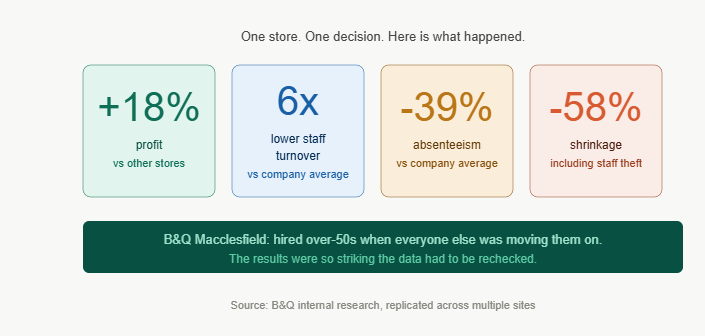
They piloted an over-50s recruitment strategy at their Macclesfield store. What they hadn’t anticipated was what emerged. Profits were around 18% higher. Staff turnover was six times lower. Absenteeism fell by 39%. Shrinkage – including staff theft – dropped by 58%. The results were so striking the data had to be rechecked.
When older employees wanted holidays at Easter and Christmas, rather than tightening the rota policy B&Q asked them to solve the problem themselves. They recruited and trained their own cover from family, local networks and nearby colleges, and took responsibility for making sure younger colleagues were floor-ready. It became known internally as grandparenting contracts – and it became the foundation of really inspiring intergenerational teams.
One employee in his 90s sat in the store answering gardening questions all day. Employees came in on their days off to check their younger colleagues were looking after their aisles properly. Nobody asked them to. They just cared.
Having a mix of generations wasn’t a nice-to-have. It turned out to be the thing that drove performance above industry averages across almost every metric that matters.
Where this connects to the bigger picture
There is a lot of discussion at board level right now about skills shortages, AI readiness, employee engagement and purpose. These feel like separate workstreams. I think they are connected by something most strategies are not currently addressing.
Organisations have a generation of experienced people who are disengaged, underused or already gone. They have younger employees who are capable but need guidance, practical experience and the kind of professional confidence that takes time to develop. And they are facing a talent shortage that is going to get significantly worse before it gets better.
The companies that start joining these dots now will be in a very different position in five years from the ones that keep treating them as separate HR problems.
I explore this in detail in my book Expiry Date Never, published by Pearson in September. I include case studies and comments from three inspirational leaders, Morag Lynagh – the globally known former Unilever leader; Adam Middleton, former VP Europe of Siemens Energy and Michele Dennison, former head of HR operations at Oxfam. The three of us have met and thrashed out current issues facing corporates and shared thinking around what needs to be done. Morag led a globally recognised piece of work for Unilever around just this topic. It wasn’t about diversity or HR but solving a strategic business issue. Unilever was in danger of having business critical skills shortages. The solution was to do more with their existing workforce.
But you don’t need to wait for the book to start asking the questions above.
The board that is addressing these five questions will already be seeing their own competitive advantage.
I would love to know which of the arguments above feels most compelling for you or your organisation – the talent economics, the knowledge risk, the AI oversight point, the changing customer demographic, or something else entirely. The conversation is more useful if it goes in more than one direction. And we would all love to share with you our own thinking, research and ideas on solutions.
Victoria Tomlinson is founder of Next-Up and author of Expiry Date Never, published by Pearson in September 2026. She speaks at the FT Weekend Festival on 5 September.

Written by Victoria Tomlinson
Victoria Tomlinson has spent her career challenging how work is done and who gets to do it. One of the few women in senior roles early in her career, she built a track record of "firsts", from being the first female graduate trainee in a 20,000-employee engineering business to becoming one of the youngest leaders in EY's London practice, where she led a division of 100 people and drove a major culture change programme. She went on to found and run an award-winning communications agency while raising a family, later expanding internationally with an office in Dubai. In her 50s and 60s, Victoria reinvented again – becoming a BBC Expert Woman commentator, launching Next-Up to help the 50+ generation rethink their working lives and more recently building a tech platform piloted by a major bank to support longer, more flexible careers. Today, as CEO of Next-Up, she works with leading professional services firms and corporates to help them unlock the value of experienced talent. Her work has created a global community of firms rethinking partner careers and later-life transitions. Victoria is an international keynote speaker, TEDx speaker (A Generation of Wasted Talent) and Amazon bestselling author. She is a Teaching Fellow at Lancaster University, a Fellow of the RSA, and has held board roles including founding Chair of WILD Digital, University of Leeds Management Advisory Board and on the board of Northern Ballet. She also supports employment initiatives for ex-offenders through HMP Askham Grange. Expiry Date Never brings together the insights from her work with individuals and organisations to challenge how we think about age, work and experience and to show what needs to change.
