

LinkedIn for Senior Partners
21 July 2026 By Victoria Tomlinson
Why They Don’t Use It, Why That Has to Change, and 20 Tips to Get Started
‘I’m surprised how easy it actually is.’ That is what a very senior partner at a major national law firm said to me recently, about 45 minutes into a LinkedIn training session. He had been a partner for over twenty years. He was leaving to pursue a portfolio career. And he had essentially never used LinkedIn himself. Not really.
To be honest it is frequently cited as the most surprising thing about our workshops. I remember Charles Penney, at the time senior partner for Addleshaw Goddard who went on our very first workshop for the firm some years ago. He said, “Much to my surprise, I found the session on LinkedIn extremely valuable.’ You can read more in this case study.
Getting individual lawyers and partners to own LinkedIn is something that Simon Marshall is currently doing, showing how LinkedIn can contribute far more measurable value to professional firms than traditional marketing. And the value to individuals who no longer work for a corporate or professional firm is immeasurable. But sadly it can take them several years to realise this or develop the skills they need.
So. let’s cover some of the essentials.
The Partner Problem
Here is how LinkedIn tends to work in professional services firms: marketing sends something round, asks partners to circulate it, and they do. They press the share button when prompted. They might add a line. But they are not in there themselves, reading, commenting, thinking, posting. They do not have a profile that means anything, do not know how the algorithm works and have never tagged anyone or been tagged.
And so when they leave, or when someone suggests they should develop a personal profile and start positioning themselves for a trustee role, non-executive career or newly started consultancy, they are starting from scratch. Except they are not 25 anymore. They are 50-something. They are very good at what they do. And they can feel faintly ridiculous learning to do something that their children mastered a decade ago.
The irony is that these are exactly the people LinkedIn works best for. They have knowledge, credibility, a network, something to say. They just have not learned to say it there.
The other thing to understand is that only around 20% of their connections will see any given post. They assume whatever they post will be seen by everyone in their network. So even the people who have been occasionally sharing marketing content think they have a reach they do not actually have.
20 Tips for the LinkedIn Beginner Who Is Not Really a Beginner
1. Start by liking. You do not have to post to get started. Go in every day and Like things that interest you. That is step one and it is easy. Go to the bottom of a post and you will see the options to Like (or Love, Applaud etc), Comment and Repost (with your own comments or just reshare without adding your own comment)
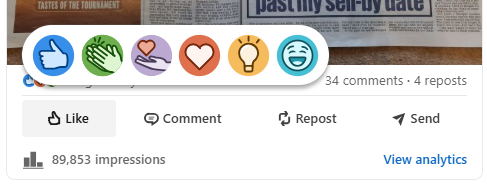
2. Then start commenting. A comment does far more for your reach than a Like. Two sentences of a natural reaction is enough. ‘Loved this post. I think the ideas could apply to students at college as well as universities?’ You do not need to write an essay. And a question encourages engagement – more likely to get others to agree or disagree or add further thoughts.
3. Always personalise a connection request. On your phone: click the three dots on someone’s profile, then ‘Personalise Invite’. On your phone, DON’T click ‘connect’ or it sends a connection request without any message. On your laptop, it will ask if you want to add a note. Always say yes. A blank request is easy to ignore.
4. Have a standard connection message ready. Something like: ‘We met at the event last week. Great to connect. Would love to stay in touch.’ Or if you are in transition: ‘Just left [firm] after many years. Building up my LinkedIn. Would be great to reconnect.’ Keep it human, keep it brief. You may want to add ‘Let’s have a coffee’ if you are building new connections.
5. Think of LinkedIn as your new CRM system that updates itself. So when you connect with someone, see if you can do a brief message that over time will remind you how you know each other and some context. It can do the job of marketing or a PA if you help it! So your message could say, ‘Great to meet you at the Leeds Nexus event on Thursday – did you manage any helpful conversations with investors?’
6. Get to 1,000 connections as a medium-term goal. Fewer than 500 and your posts have very limited reach. Connect to 10 new people a week. 50 a week if you can. University contacts, former colleagues, clients, people from events, people you have had coffees with. Set up a plan and structures with what you will do each day and each week.
7. You may need LinkedIn Premium while you are in an active networking phase. LinkedIn’s algorithms are secret and keep changing but theoretically at the moment you should be able to do 100 connections a week (max of 20 a day) without needing premium. If you keep below, say 80 then at the moment you should be OK. Otherwise you will be blocked for a while unless you upgrade to premium. There is another use of Premium – you can see who has viewed your profile. That is more useful than it sounds: people who look at your profile are often already curious about you, and you can follow up. Send them a connection message and start a conversation. You can cancel Premium once you have built up a strong network base.
8. Understand that only about 20% of your network sees each post. Initially. The algorithm sends it first to the people who engage with you most, who are probably not to the people you most want to reach. If you have a kind son or daughter or a former trainee who is diligently following your every word, then LinkedIn will see them – and others Like them – as the most engaged. They are trying to make sure people get content they want to see. If you start getting comments and reshares, you will see your post going wider. I know when I get 2nd and 3rd degree connections (ie I haven’t connected to them directly) commenting on my posts, then it is not only going to all my network of 11.5k people, but also much wider to people I don’t know. This is why comments and reposting matter so much and far more than Likes.
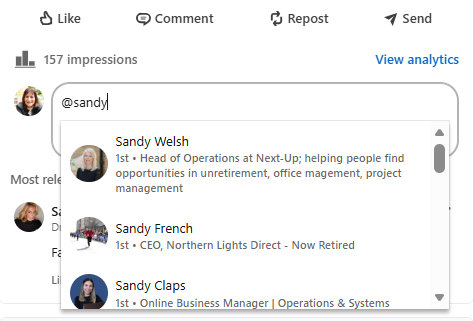
9. Tag people when it is genuine. If you met someone at an event and want to reference the conversation, tag them. If you are sharing something and want their view, tag them. Do not over-tag. But used well, it pulls their network into your post. To tag someone, write their name with an @sign first – if you are doing a reply to a post their name should come up at the top. I have started tagging my colleague here to show you. The name should come up as you type – and put an underscore between their first and second name eg @sandy_welsh. This is not one of LinkedIn’s best features and occasionally you can’t get someone’s name to come up at all – just move on!
10. If you can, repost with your thoughts rather than just reposting. Find something worth sharing, press ‘Repost with your thoughts’, and add two or three sentences of your own reaction. This is the easiest way to start posting before you feel ready to write from scratch.
11. Decide on three or four themes and stick to them. LinkedIn’s algorithm learns what you are about. If you comment and post on risk and governance, it will start sending you content on risk and governance. If you scatter-gun, it cannot categorise you and neither can the people looking at your profile.
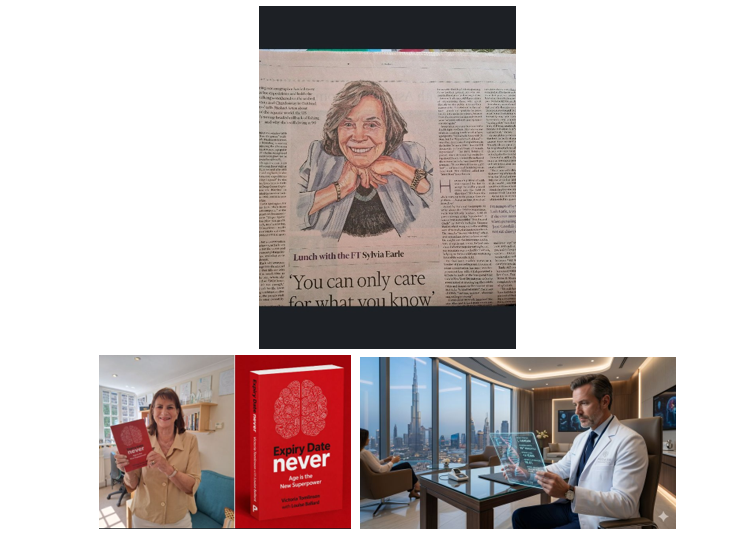
12. Always use an image. Look at your feed. Almost every post with any traction has one. It does not have to be professional: a photo of a newspaper you are reading, a shot from an event, an AI-generated image. Anything. A wall of text stops people scrolling.
13. Write like you talk. Read it back out loud before you post. If you would feel awkward saying it across a table, cut it. ‘Genuinely excited to share’ is an AI giveaway. ‘I found this interesting because’ is a human being.
14. Use AI to help you shape content, but put it back into your words. AI is very good at structure and first drafts. It is terrible at sounding like you. Use it as a starting point, not a finishing point.
15. Post once a week to start. Saturday or Sunday morning works well for many people. Reflect on what came up in the week. What themes did you hear in meetings? What surprised you? What are you thinking about? That is a post. Remember your brand and post thoughts that reflect what you are good at or want to be the go to person for
16. Ask a question at the end of a post when it feels natural. Not forced. Not ‘What do you think?’ at the end of everything. But a natural ‘Has anyone else found this?’ or ‘What would you add?’ invites engagement and engagement drives reach.
17. Build a small engagement pod for posts that matter. This is five to ten people, people who know you, who you can message privately to say: I have posted something I would love some engagement on. Could you comment or repost it? Liking is not enough. You need comments to shift the algorithm.
18. What you post is fine but you will have the most impact by building relationships with others. You can do this by commenting on other people’s posts in your target space. Find the people you want to do business with and follow them. Put that list on a board and check their profiles every few weeks, see what they are up to. When they post something relevant, comment thoughtfully. You are not just engaging with them: you are visible to their network.
19. Reciprocate. When you have a coffee with someone, think about who you could introduce them to. Take a selfie of the two of you (I know, but you are moving into this new world!) and post with a short comment ‘So good to catch up with John X. He is mentoring a fast growing tech business with young founders and they are looking for their first non-exec. The business does xyz. Anyone suggest names for them to consider?’ Don’t post about yourself, post to add value to others. When someone connects, think about whether there is someone they should know. The people who are known as connectors become very valuable very quickly.
20. Update your profile regularly. You do not have to get it perfect before you go live. Get it good enough and publish it. Then update it as your thinking develops, as you take on new roles, as your positioning sharpens. It is not a one-time document. It is a living thing.
And finally a few other blogs that might be helpful.
7 tips to write a profile for mentoring/non-executive director roles!
How my sister’s Pet Portraits prove LinkedIn isn’t just for suits and CVs – Next-Up
14-day New Year action plan to make LinkedIn work
7 inside secrets to making LinkedIn really work
8 LinkedIn essentials for a winning (unretirement) profile
Victoria Tomlinson works with senior executives in transition, helping them build their personal brand, develop a portfolio career and get to grips with the tools and habits that make them visible and valuable in a new chapter. If you would like to talk, get in touch.

Written by Victoria Tomlinson
Victoria Tomlinson has spent her career challenging how work is done and who gets to do it. One of the few women in senior roles early in her career, she built a track record of "firsts", from being the first female graduate trainee in a 20,000-employee engineering business to becoming one of the youngest leaders in EY's London practice, where she led a division of 100 people and drove a major culture change programme. She went on to found and run an award-winning communications agency while raising a family, later expanding internationally with an office in Dubai. In her 50s and 60s, Victoria reinvented again – becoming a BBC Expert Woman commentator, launching Next-Up to help the 50+ generation rethink their working lives and more recently building a tech platform piloted by a major bank to support longer, more flexible careers. Today, as CEO of Next-Up, she works with leading professional services firms and corporates to help them unlock the value of experienced talent. Her work has created a global community of firms rethinking partner careers and later-life transitions. Victoria is an international keynote speaker, TEDx speaker (A Generation of Wasted Talent) and Amazon bestselling author. She is a Teaching Fellow at Lancaster University, a Fellow of the RSA, and has held board roles including founding Chair of WILD Digital, University of Leeds Management Advisory Board and on the board of Northern Ballet. She also supports employment initiatives for ex-offenders through HMP Askham Grange. Expiry Date Never brings together the insights from her work with individuals and organisations to challenge how we think about age, work and experience and to show what needs to change.
